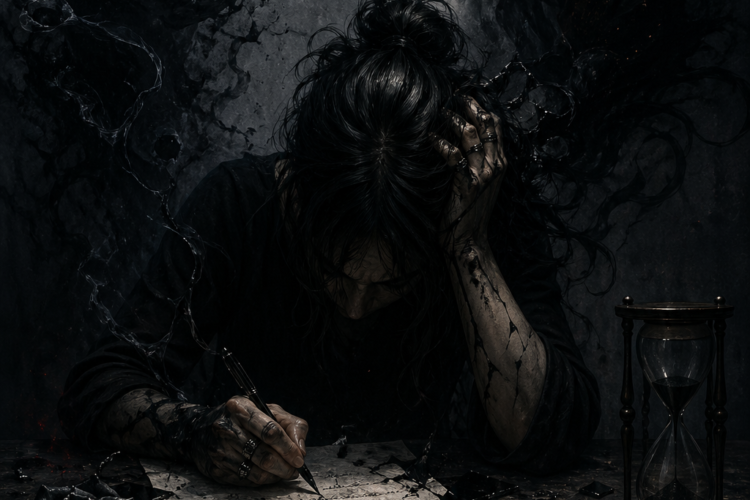
There’s a long-standing tradition in poetry—dating back to Horace—called ars poetica, or “the art of poetry.” It asks a simple but loaded question: why do we write?
For some, poetry is beauty. For others, it’s truth.
For me, it’s survival.
Today’s poem doesn’t soften that reality. It leans into it. It acknowledges the internal battles, the noise, the pressure, and the fragile line between control and collapse. This ars poetica isn’t about craft in the traditional sense—it’s about necessity. Writing as release. Writing as containment. Writing as a way to keep identity intact when something darker threatens to take hold.
This is what poetry does for me: it gives shape to what would otherwise consume me.
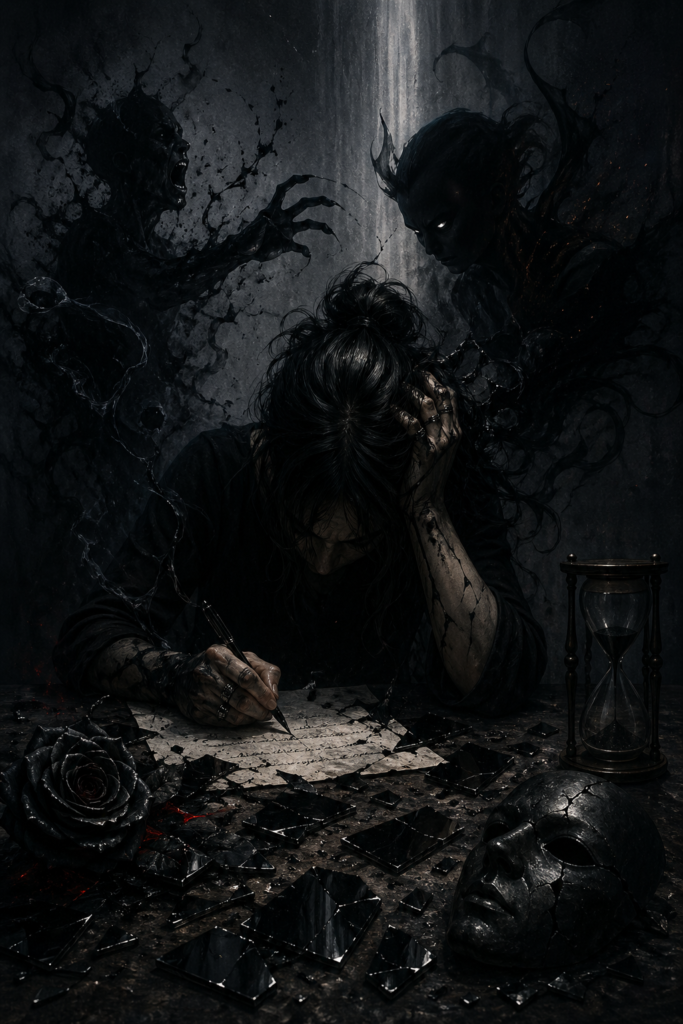 Ars Poetica: Fractured Voice
I write from the edge of something broken—
not metaphor, not softness—
but the jagged aftermath
of a heart that did not survive intact.
Each line is a fingertip
dragged across shattered glass,
feeling for shape in the pain,
naming what refuses to stay buried.
I write because the dark in me is loud.
Because silence feeds it.
Because if I do not open a door
it will break one down.
There are voices—
not whispers, never that gentle—
they rise like pressure in closed rooms,
they press against bone,
they demand.
So I give them fragments.
Measured. Controlled.
A page becomes a narrow escape route,
a place where something inside me
can leave
without taking all of me with it.
Call it survival.
Call it containment.
My soul is not light—
it does not pretend to be.
It carries weight, density,
a darkness that reflects nothing back.
But even obsidian can cut,
can shape,
can be held with care
if you know where the edge is.
I write to keep that edge visible.
Because there is something waiting—
something patient—
something that would wear my name
like a mask if I let it.
And I will not.
Let it claim what it believes is owed.
Let it circle, whisper, threaten.
It does not get all of me.
Not the part that chooses the words.
Not the part that still draws a line
between voice
and self.
So I stay awake.
I write in the hours where shadows stretch longest,
where fear feels closest to truth.
And with every poem,
I take something back—
not victory, not peace—
but space.
Enough space to remain
who I am.
Poetry doesn’t always heal. Sometimes it doesn’t even comfort. But it does bear witness. It names what’s real, even when that reality is dark, fragmented, or difficult to face.
And sometimes, that’s enough.
🖤✍️🔥